Discover Save Wild Academy
Four ways into the story.
Choose an image or headline to open the details.
Cartoon teaching illustrations—not photographs of completed projects.
01 / ExploreThe AcademyEveryday lessons. A connection with nature.Click to exploreClose section
Learning for people and nature
The environment is already part of a child’s world.
A tree shades the schoolyard. A butterfly visits a flower. Rain changes the ground beneath our feet. A family story explains how a place has changed. These everyday experiences can help children understand both their schoolwork and their relationship with nature.
Save Wild Academy, an ECOWICE initiative, helps teachers make those connections deliberately. A mathematics lesson can use grouping and counting. An English lesson can build a story from a garden observation. History can explore the relationship between community heritage and the natural world.
The aim is to make environmental learning a practical part of ordinary teaching. The platform is organised around Standards III–VI and six subjects: Mathematics, English, Kiswahili, Geography, History and Science. This visual story highlights five of those subjects; teachers can explore the library for the lessons currently available.
A practical teaching rhythm
From curiosity to understanding—and action.
Lesson guides use the SCEPT framework: Shirikisha, Chunguza, Eleza, Panua, Tathmini. In English, this is Engage, Explore, Explain, Extend and Evaluate. It gives teachers a clear sequence while leaving room to use familiar local examples.
- EngageStart with a picture, object, question or experience children recognise.
- ExploreLet pupils observe, compare, investigate or discuss.
- ExplainHelp pupils describe what they found and connect it to the subject.
- ExtendApply the learning to a new example or a practical environmental choice.
- EvaluateCheck understanding through answers, drawings, pupil work or demonstration.
Activities should suit pupils’ ages and local conditions. Teachers guide safe observation, avoid disturbing living organisms, and choose appropriate materials and locations.
02 / ExploreSubjects in ActionFive subjects. Many ways to learn.Click to exploreClose section
Five windows into the approach
One environment. Many ways to learn.
Each poster below shows a possible learning sequence: notice something, investigate or discuss it, then explain or apply what has been learned. Open a subject below to explore its lesson and poster.
About the images: these AI-generated cartoon teaching illustrations are based on Academy lesson materials. They demonstrate learning activities; they are not photographs documenting completed school projects or measured results.
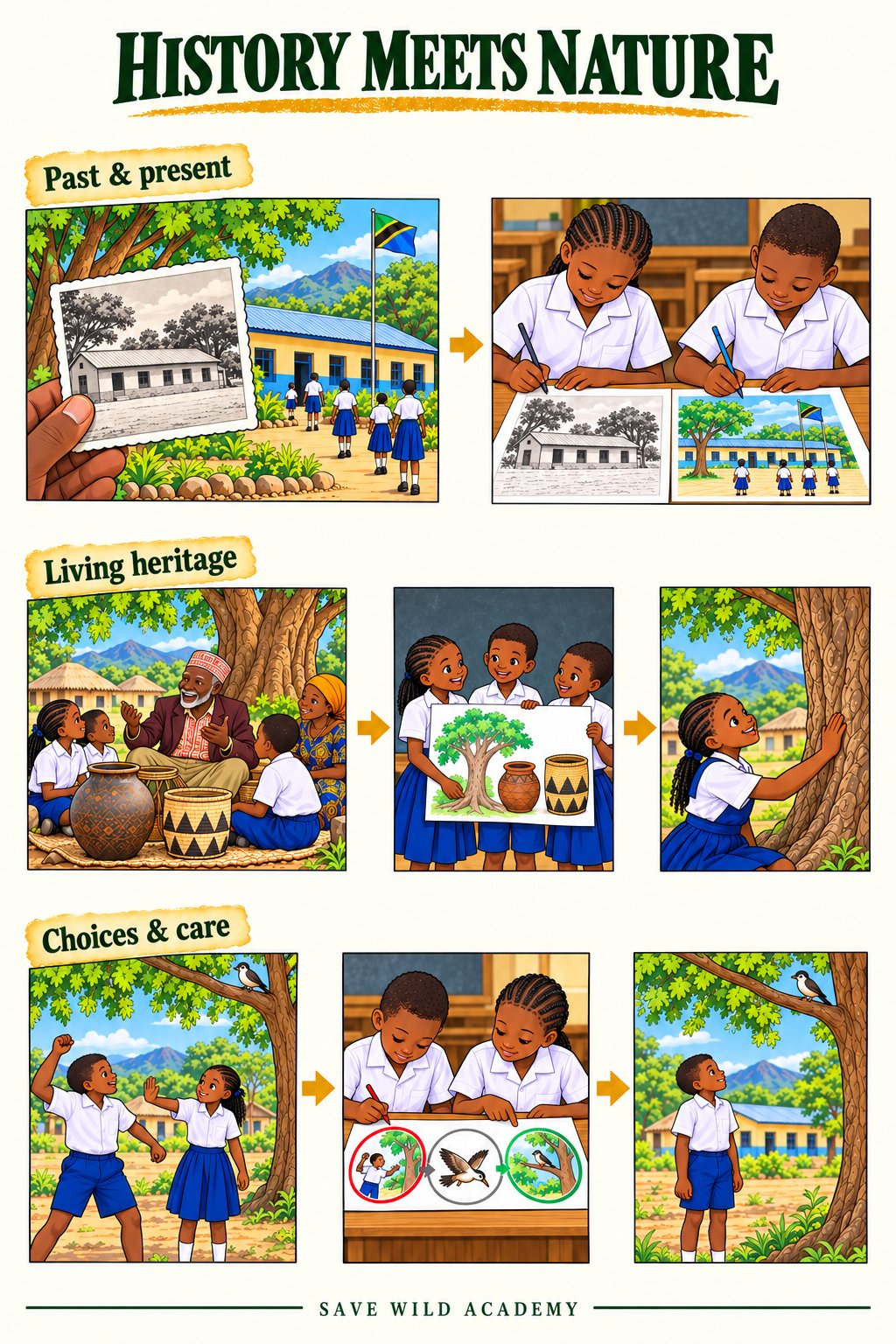
HistoryThe past helps us care for the future.
01 / A subject story
History meets nature.
The subject learning
Comparing past and present, listening to community accounts, and exploring heritage and responsibility.
What the lesson can look like
Children compare pictures of their school at different times, listen to an elder, and discuss the trees, materials and places connected to community life. A conversation about choices becomes a practical question: how should we treat a bird living in our school grounds?
The environmental connection
Nature becomes part of a shared history. Caring for trees and wildlife connects with respect for community heritage and responsibility for the places children inherit.
Explore History lessons →MathematicsNumbers become meaningful outdoors.
02 / A subject story
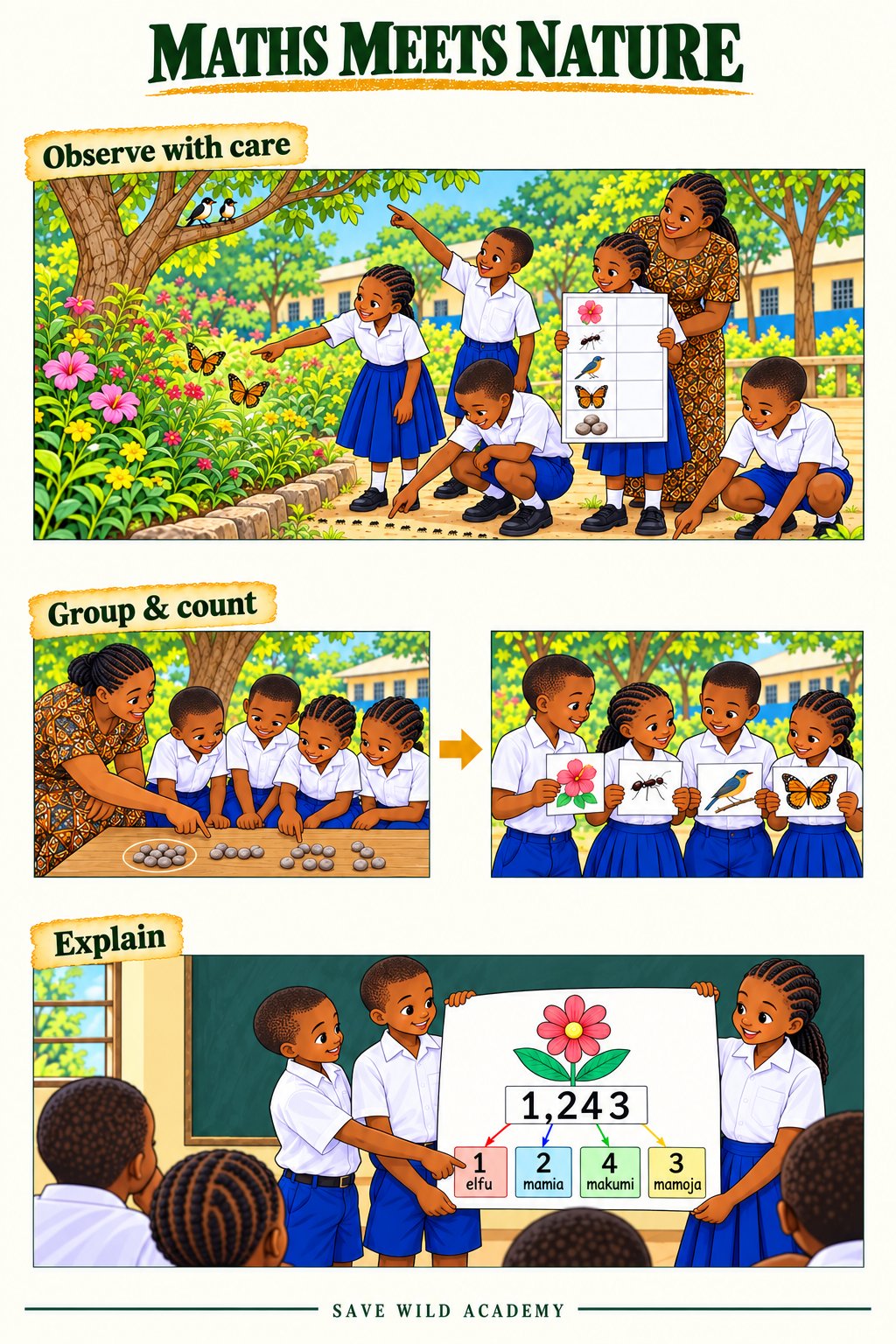
Mathematics meets nature.
The subject learning
Observing, grouping, counting, representing numbers and explaining place value.
What the lesson can look like
A school garden offers a starting point for noticing and comparing. Children use stones and picture cards to organise quantities, then explain how a number is built from thousands, hundreds, tens and ones. Living organisms can be observed and represented without being collected.
The environmental connection
Pupils practise mathematical reasoning while learning to observe their surroundings carefully. The same habits of counting and recording can help them describe what they see in their environment.
Explore Mathematics lessons →EnglishThe living world gives children something to say.
03 / A subject story
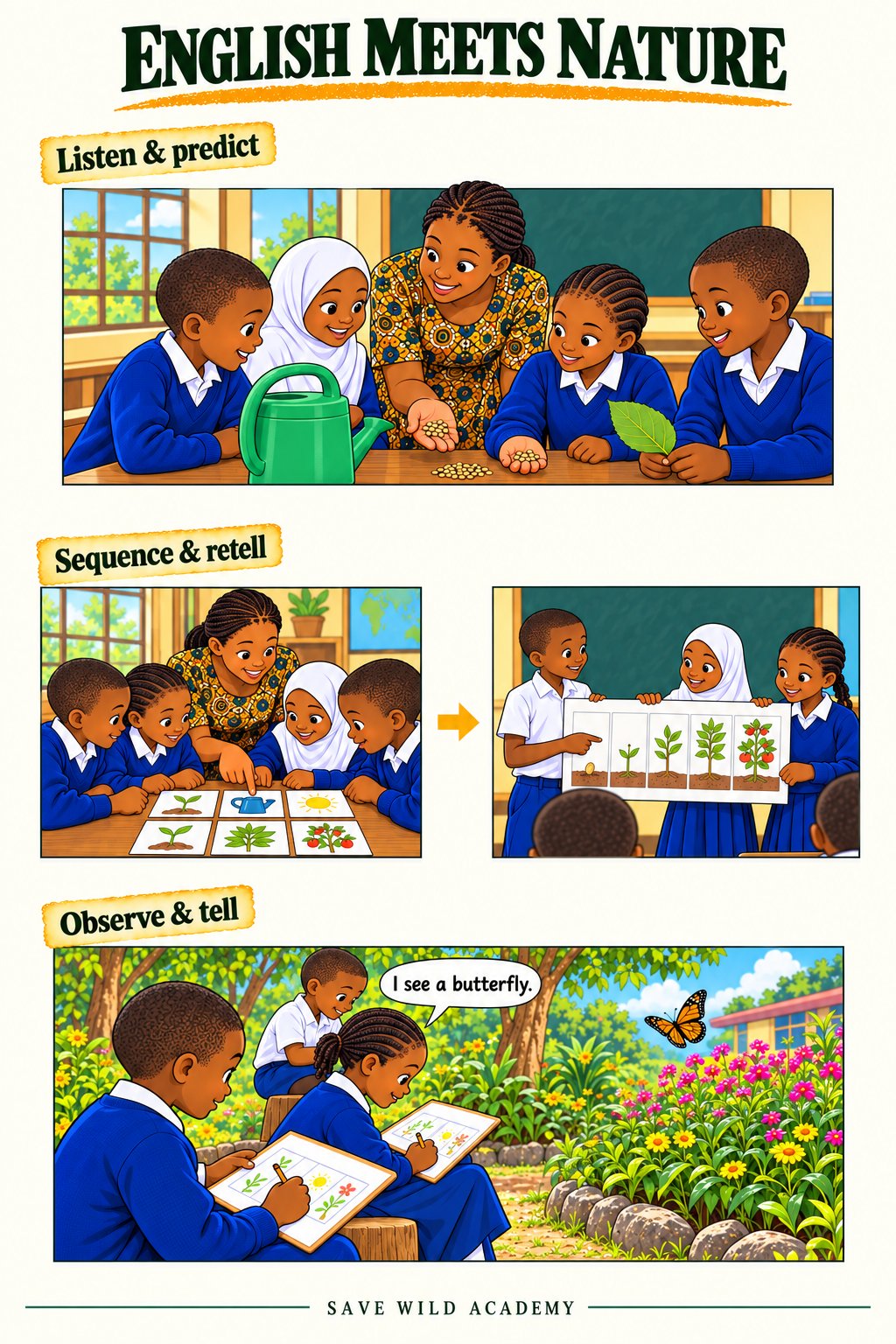
English meets nature.
The subject learning
Listening, predicting, sequencing, retelling and describing observations in English.
What the lesson can look like
A teacher introduces seeds, a leaf and a watering can. Children arrange picture cards into a sequence and retell the story. Outside, they describe what they notice—a flower, a butterfly or a growing plant—using simple sentences.
The environmental connection
Language practice grows from an experience children can see and discuss. Describing nature helps build vocabulary alongside attention to living things.
Explore English lessons →ScienceEvidence guides everyday care.
04 / A subject story
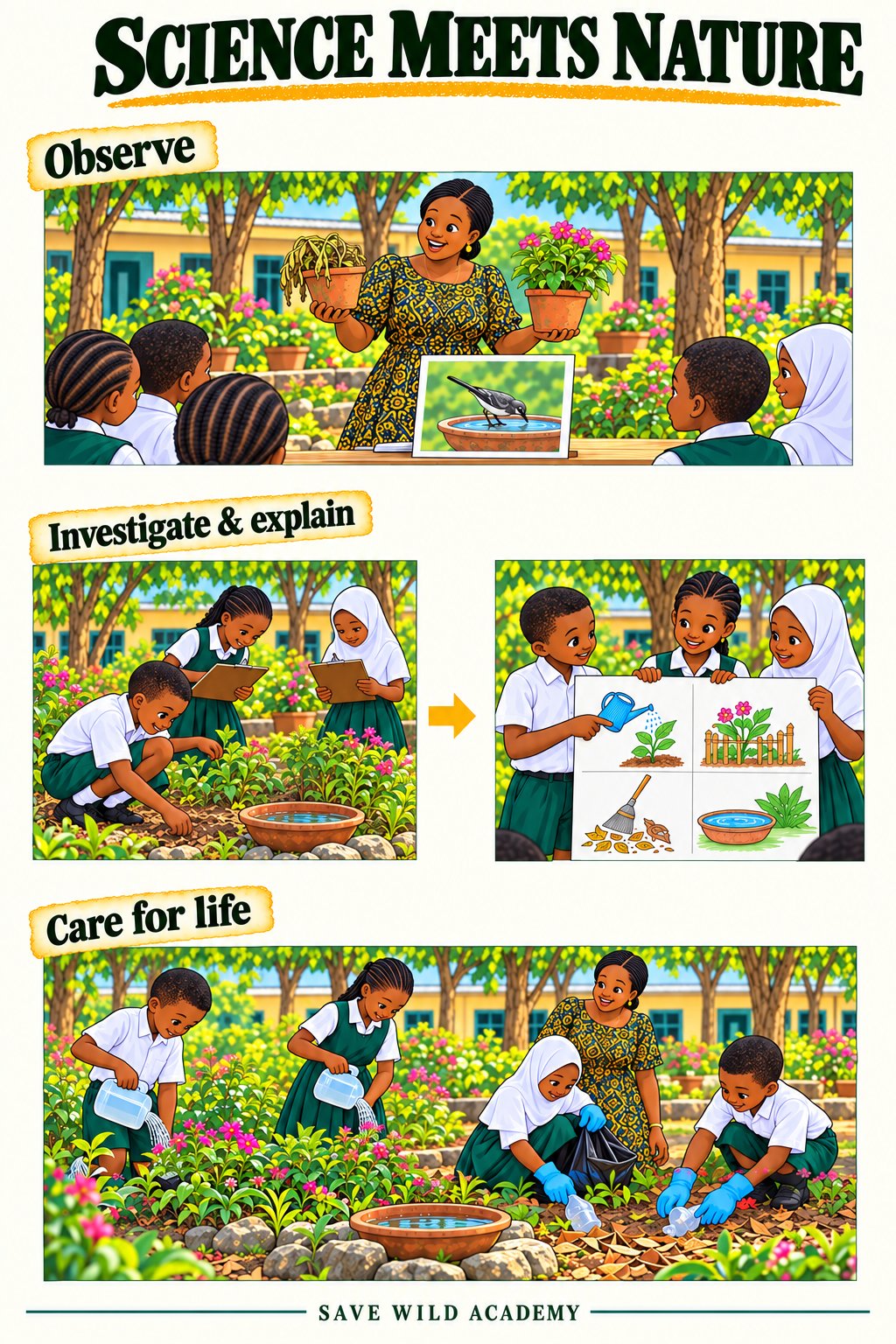
Science meets nature.
The subject learning
Observing differences, asking questions, gathering evidence and matching an action to a need.
What the lesson can look like
Children compare a wilted plant with a healthy one, investigate soil and water, and explain what living things need. With teacher supervision, they practise appropriate watering and collect litter safely. Their drawings help explain why each action matters.
The environmental connection
Care is linked to evidence: a dry plant needs attention, clean water supports life, and litter can be removed safely. Pupils learn to explain an action rather than simply repeat an instruction.
Explore Science lessons →GeographyKnowing a place is the first step towards caring for it.
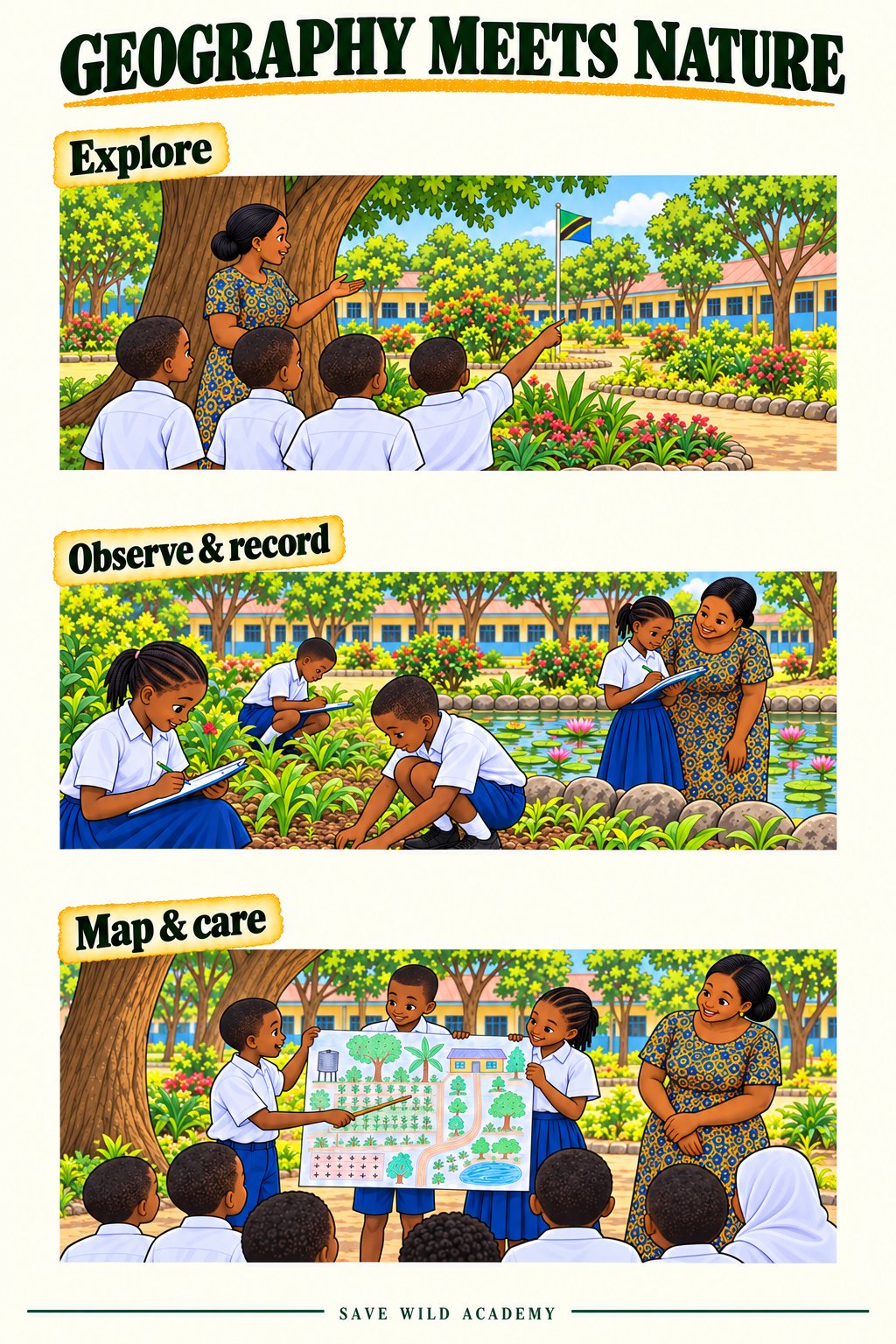
05 / A subject story
Geography meets nature.
The subject learning
Identifying natural and human-made features, observing locations, recording findings and representing a place.
What the lesson can look like
The school grounds become a place to investigate. Pupils notice trees, soil, buildings, paths and water features, record their observations and present a picture map. They discuss how people use the space and how its natural features can be cared for.
The environmental connection
Geography links the places children know with the choices people make. A map becomes a way to talk about both learning and looking after a shared environment.
Explore Geography lessons →03 / ExploreThe Teacher JourneyLearn, prepare, teach and share evidence.Click to exploreClose section
How the online platform engages teachers
A continuing journey, from preparation to practice.
The platform brings training, lesson resources and implementation follow-up together. Teachers can return to their learning, see their progress and use their account to connect preparation with the next practical step.
Join
A teacher creates an account and provides school and teaching information. The platform connects their learning and requests to their teaching context.
Learn
Teachers work through foundation training, reflect on their own classrooms and complete knowledge checks. English-subject training is available in English; other teacher-facing learning uses Kiswahili.
Prepare
Teachers explore subject lesson guides and slides, complete the relevant learning requirements, and plan how to adapt activities to their pupils and available surroundings.
Request support
Where support is needed, a teacher submits a lesson-linked plan and budget. ECOWICE reviews requests; assistance depends on approval, eligibility and available resources.
Teach and document
The teacher delivers the lesson and records what happened through pupil work, reflections and appropriate supporting evidence. The online preparation leads to real classroom and outdoor learning.
Reflect and improve
Reports and evidence enter the review process. Feedback helps teachers improve, while reviewed information provides a basis for donor updates and decisions about further support.
Knowledge checks make participation more than reading a page. The current foundation training includes module questions and a final assessment with an 80% pass threshold. Reflection asks teachers to think about how the approach fits their own setting. Facilitator and ECOWICE review add a human connection to the online process.
Teacher sign-in and registration →A clear line of sight
What should support make possible?
The intended pathway is straightforward: better-prepared teachers deliver meaningful lessons; pupils practise subject skills through environmental experiences; teachers document the learning and actions; ECOWICE reviews the evidence and uses it to improve the programme.
A completed training module shows participation in training. A delivered lesson shows implementation. Neither alone proves a lasting change in behaviour or wildlife conservation. Those longer-term outcomes need follow-up. Donor communication should make these distinctions clear.
Useful donor updates can bring together:
- The teacher, school, subject and purpose of the supported lesson.
- Activities completed, dates and reported pupil participation.
- Examples of pupil work and what teachers observed about learning.
- Environmental actions taken, such as caring for a garden or avoiding harm to wildlife.
- Approved use of support, implementation challenges and next steps.
- The review status, with consent-appropriate images and no unnecessary child-identifying details.
The posters in this article explain the approach. Implementation reports and reviewed school evidence are the basis for reporting actual reach and results.
04 / ExploreHow You Can HelpSupport teachers. Bring lessons to life.Click to exploreClose section
How donors can engage
Help a good lesson become a lived experience.
Individuals, foundations, businesses and education partners can discuss support with ECOWICE. Start with the part of the journey you want to strengthen, then agree a realistic scope, budget and reporting arrangement.
A simple way to begin
- Tell us your interest. Choose a subject, a type of support or a broader education and conservation goal.
- Agree a practical plan. Ask ECOWICE about current priorities, teacher readiness, eligible requests and available budgets.
- Support the agreed work. Confirm the contribution method, responsibilities and reporting expectations directly with ECOWICE.
- Learn from the results. Review implementation updates, ask questions and decide together what should be improved or continued.
No fixed sponsorship price or guaranteed conservation outcome is implied. Support is matched to reviewed needs and the resources available.
Let’s start with a conversation
Invest in teachers.
Bring learning to life.
Tell us which part of Save Wild Academy interests you. We can discuss current priorities and how your support could help teachers connect curriculum learning with care for nature.
savewild@ecowice.org · ECOWICE · Morogoro, Tanzania
Questions donors may ask
Is this an online course for children?
The online platform primarily supports teachers. Teachers then lead pupils through classroom and outdoor activities using the lesson resources.
Do the posters represent completed projects?
No. They are cartoon teaching illustrations that show the approach. Actual implementation is documented separately through teacher reports and reviewed evidence.
Can I support a particular subject?
Yes, you can express a preference when contacting ECOWICE. A specific commitment should be agreed against current priorities, readiness and a reviewed plan.
Does finishing training guarantee funding?
No. Teachers submit support requests for review. Approval and assistance depend on the request, eligibility and available resources.
Can I share this article?
Yes. Share this page with colleagues and partners who are interested in education, teacher development and environmental conservation.
Share the article by email →Ready to support teachers and environmental learning?
Talk to ECOWICE →